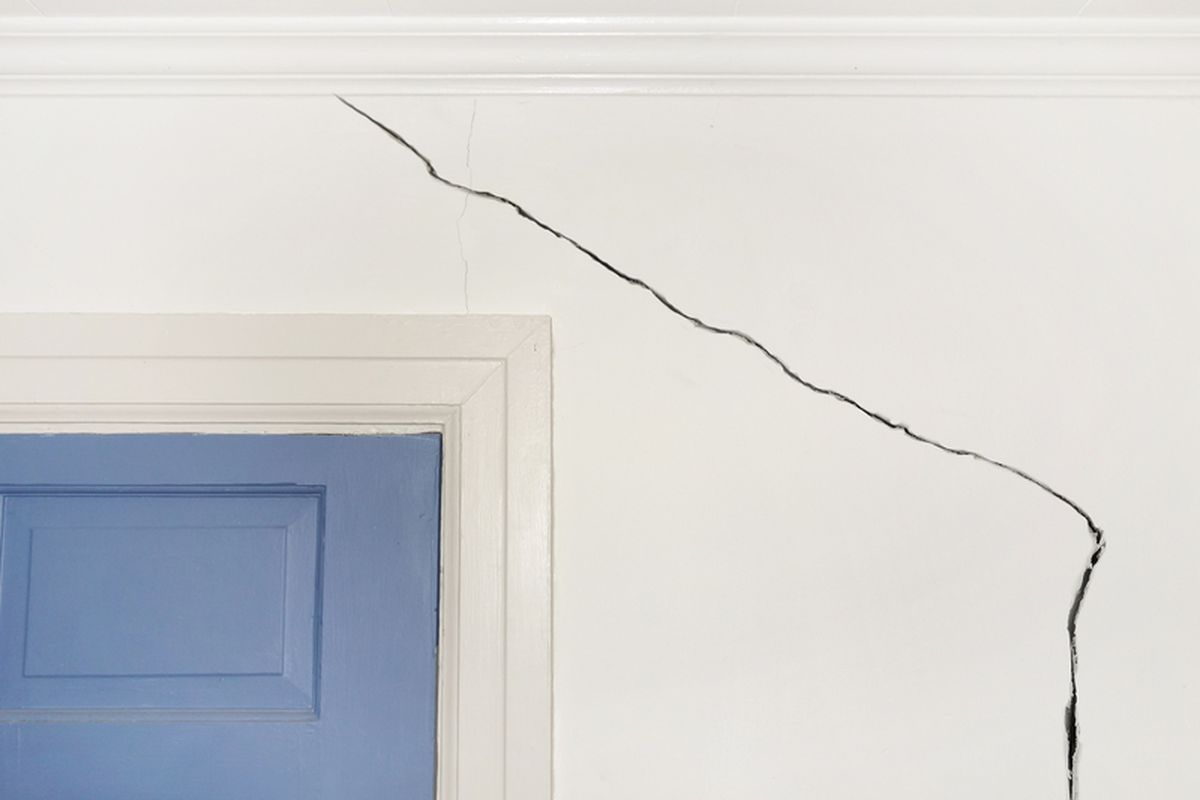
Why Hairline Cracks in Walls Aren't Necessarily Dangerous
26 September 2026
What is a hairline crack?
As the name suggests, a hairline crack is a very thin, small crack, usually appearing like a fine line on the wall surface.
These cracks often appear on:
- the paint layer
- plaster
- the skim coat (acian)
- joints between materials
- areas around doors or windows
In many cases, hairline cracks only occur in the finishing layer and do not directly indicate structural damage to the building.
However, that doesn't mean all thin cracks can be ignored.
What's important is looking at the location, pattern, direction, and progression of the crack.
Why do hairline cracks appear?
There are several fairly common causes.
One of them is material shrinkage.
When plaster, skim coat, or finishing material dries, it can undergo slight shrinkage.
This process sometimes produces thin crack lines on the surface.
In addition, hairline cracks can also be influenced by:
- temperature changes
- humidity
- the quality of the plaster or skim coat mixture
- the thickness of the finishing layer
- a drying process that wasn't optimal
- small movements in the building materials
So, seeing one or two thin cracks on a wall doesn't necessarily mean the house immediately has a structural problem.
What kind of hairline crack usually doesn't need much worry?
Not all cracks carry the same level of risk.
Cracks that are:
very thin,
only on the surface,
not increasing in length or width,
and
not accompanied by other changes in the building
generally point more toward a finishing issue rather than structural damage.
For example, you notice a thin, hair-like line in the paint layer.
Upon inspection, the crack doesn't go deep and hasn't changed over time.
In such conditions, the fix might simply be repairing the finishing before repainting.
But it should still be monitored.
Because the condition of a crack can change over time.
So, what kind of crack needs attention?
Well, this is where you need to be more thorough.
A crack deserves more attention if:
1. The crack is getting wider
It starts as a thin line, but over time becomes increasingly noticeable.
This shows that the crack is progressing.
2. The crack is getting longer
If the crack line keeps extending over time, don't just cover it with paint.
Find out the cause.
3. The crack appears in a diagonal pattern
Diagonal cracks, especially ones that are quite visible and progressing, need further attention.
Especially if they're around the corners of doors or windows.
It doesn't necessarily mean it's dangerous, but the context needs to be checked.
4. The crack penetrates into other parts
If the crack is visible not only in the paint or skim coat but also involves the plaster or deeper materials, further inspection becomes increasingly important.
5. Accompanied by doors or windows that are hard to open
This is something worth paying attention to.
If a crack appears alongside changes to a previously normal door frame, door, or window, don't just assume it's a paint issue.
Check whether there are other changes in the building.
6. Appears together with changes in the floor or wall
For example, there is:
- a floor that has shifted position
- a wall that appears to have shifted
- a wall surface that is bulging
- leaks or heavy dampness
- new cracks in many areas
If several signs appear together, further inspection by a professional is recommended.
Don't just look at "how big" the crack is
This is a fairly common mistake.
People often think:
"The crack is small, so it's safe."
In fact, size isn't the only factor.
What also needs attention is:
the direction of the crack
its location
the pattern of the crack
whether it's getting bigger
whether other cracks are appearing
and whether there are changes in other parts of the house.
A stable, thin crack might not be too concerning.
On the other hand, a crack that keeps progressing, even if small at first, still needs attention.
How do you monitor a hairline crack?
There's no need to immediately tear down the wall.
You can do simple monitoring first.
For example:
1. Photograph the crack
Take photos from the same distance so they're easy to compare.
2. Note the location
For example, the crack is on the living room wall near the window.
3. Observe its progression
Does the crack stay the same, or does it keep getting longer and wider?
4. Observe the surrounding conditions
Is there dampness, seepage, floor changes, or a door that's becoming hard to open?
That way, you'll have an idea of whether the crack is stable or progressing.
Don't rush to cover the crack with paint
This is also important.
When people see a crack, many people's first response is:
grab some filler → cover the crack → repaint.
It can indeed make the wall look tidy again.
But if the cause of the crack hasn't been identified, the crack can reappear.
So the repair should be tailored to the cause.
If it's really just a finishing issue, the repair is relatively simple.
But if the crack is related to movement or other building issues, the cause must be addressed first.
What if a hairline crack is found when buying a house?
This becomes even more important.
If you're viewing a house and find a crack, don't immediately cancel the purchase.
But don't immediately assume either:
"Ah, it's just a hairline crack."
Do an inspection.
Ask the owner:
"How long has this crack been here?""Has it been repaired before?""Has the crack been getting bigger?"
Then check whether there are similar cracks in other areas.
If you find many cracks or other suspicious signs, consider requesting an inspection from a professional before making a decision.
Hairline cracks can also be an aesthetic issue
Even if unrelated to the structure, hairline cracks can still affect the appearance of the house.
A freshly painted wall can look less tidy as crack lines start to appear.
Especially if cracks appear in many areas.
In such conditions, the issue might not be the building's safety, but rather the quality of the finishing and aesthetics.
The good news is, finishing issues are usually easier to handle than structural issues.
What's important is first making sure of the type of problem.
So, when should you start worrying?
Use this simple principle:
Small crack + stable + only on the surface
→ likely more related to finishing, but still keep monitoring it.
Progressing crack + getting wider/longer
→ needs further inspection.
Crack accompanied by changes in the building
→ don't ignore it and consider a professional inspection.
Not sure about the type of crack
→ better to have it checked than to guess.
Because from appearance alone, it's not always possible to determine the exact cause of a crack.
Don't panic, but don't ignore it either
So, is a hairline crack in a wall dangerous?
Not necessarily.
Hairline cracks can occur due to various factors, and in many cases are only related to the finishing layer.
But what needs to be watched is its progression and the accompanying signs.
Don't panic right away when you see one small line on a wall.
But don't just cover it up either without understanding the cause.
Because when it comes to maintaining a house, the principle is simple:
Not every crack is a big problem.
But every crack still deserves attention.
Looking for a House in Semarang?
When buying a house, don't just pay attention to the design, number of bedrooms, or interior look.
Small things like wall cracks, floor condition, the roof, air circulation, and even the quality of the surrounding environment also need attention.
Because a house that looks great at first glance isn't necessarily free of things that need checking.
If you're looking for a house in Semarang and want to compare options based on budget, location, and needs, you can discuss it with Mirailand.
Tell Mirailand the criteria for the house you're looking for.
We'll help you weigh suitable property options, so you not only find a house that's visually appealing, but also feel more confident about your purchase decision.
Mirailand — helping you find the right place to come home to.