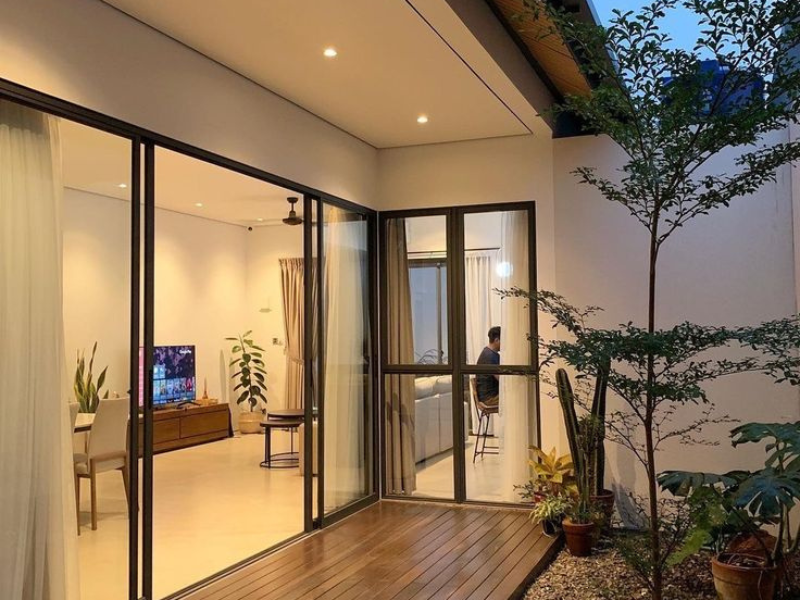
Can House Ventilation Save on AC Usage? Here's the Explanation
24 September 2026
The answer: yes, it can, but it depends on the condition of the house and how it's used.
Because ventilation is not a substitute for AC.
However, at the right time and under the right conditions, ventilation can help reduce a house's cooling load.
Why can ventilation affect a house's temperature?
Simply put, the air inside a house is constantly exchanging with air from outside.
When a house has good ventilation, hot air trapped inside can escape and be replaced with fresher air.
This is especially noticeable when:
- the outside air is cooler than the air inside
- the house has good air circulation
- there are openings on sides that allow air to flow
- the house doesn't receive too much direct sun exposure
- the ventilation is placed appropriately
For example, in the late afternoon or evening when outdoor temperatures start to drop.
Instead of continuously running the AC to cool the room, you can take advantage of outdoor air conditions by opening vents or windows at the appropriate time.
The house can feel more comfortable without the AC running constantly.
But doesn't opening windows actually make the house hotter?
True, if done at the wrong time.
This is a common misunderstanding.
Ventilation doesn't mean:
"The more windows, the cooler the house."
That's not always the case.
During the day when outdoor air is very hot, opening windows can actually let hot air into the house.
As a result, the room becomes even harder to cool.
That's why what matters isn't just the number of vents, but also:
when the ventilation is used and how it's designed.
Get to know the cross ventilation concept
One fairly effective ventilation concept is cross ventilation, or crosswise ventilation.
The method is to create openings on different sides so that air can move through the room.
For example:
a window on the front side → the room → a window on the back side.
When wind conditions are favorable, air can enter from one side and exit through the other.
The result?
Air doesn't just stop at one point.
There's an airflow passing through the room.
This can help reduce hot air and make the house feel more comfortable.
Ventilation at the top is also important
Have you ever felt that the upper part of a house feels much hotter?
There's a reason for that.
Hot air tends to rise.
That's why houses with vents or openings in higher areas can help release accumulated hot air.
Examples include:
- upper ventilation
- louvers
- roster vents
- openings near the ceiling
- ventilation in certain roof areas
The concept is simple:
hot air rises → hot air exits → cooler air enters.
This kind of design can help reduce heat buildup, especially in houses with high ceilings or areas that receive a lot of sun exposure.
The position of the house also matters
Ventilation alone isn't enough.
The direction and position of the house relative to the sun can also affect how hot a room gets.
Rooms that receive prolonged direct sunlight naturally have a greater heat load.
As a result, the AC has to work harder to reach a comfortable temperature.
That's why, when choosing or building a house, also pay attention to:
the direction the sunlight comes from
window position
opening size
canopies or overhangs
vegetation around the house
and
the materials used.
The right design can help reduce heat before it enters the house.
Plants can help too
Trees or plants around a house aren't just there to make it look more lush.
Proper placement of vegetation can help provide shade in certain areas and reduce direct sun exposure.
For example, placing a tree in an area that receives quite high sun heat.
But make sure the plants don't end up blocking all the house's openings.
Because the main goal remains:
reducing heat while maintaining air circulation.
So it's not simply:
"Lots of plants = the house is definitely cool."
Rather, it's about how those plants are placed properly.
When should you use ventilation instead of AC?
This depends on outdoor air conditions.
When the outside air is cooler and the air quality is good, opening windows or using ventilation can be an option.
For example:
in the morning
or
at night when temperatures start to drop.
On the other hand, when outdoor air is very hot, humid, dusty, or has poor air quality, opening all the windows isn't always the best choice.
In such conditions, AC still plays an important role.
So the more appropriate strategy isn't:
AC or ventilation.
But rather:
when to use ventilation and when to use AC.
Can ventilation really save electricity?
It can help, but don't expect ventilation to automatically cut your electricity bill drastically.
The savings depend heavily on the house's design, climate, building orientation, insulation quality, room size, type of AC, and even the occupants' habits.
However, if the house's design can reduce incoming heat and take advantage of natural air at the right times, the need for AC usage can be reduced.
For example:
Instead of having the AC running all day, you can make use of ventilation when outdoor conditions allow.
The lighter the house's cooling load, the lighter the AC's workload.
Don't forget: ventilation and insulation must work together
There's one thing that's often forgotten.
A comfortable house isn't just about having lots of openings.
Insulation matters too.
When heat from outside easily enters through the roof, walls, or glass, the AC will have to work harder to maintain the room temperature.
That's why a comfortable house design should consider several things at once:
- ventilation
- insulation
- building orientation
- shading
- window size and position
- building materials
- air circulation
- AC usage
So don't think:
"Install as much ventilation as possible, and the house will surely be cool."
What's needed is a balanced design.
A house with good ventilation doesn't mean it doesn't need AC
This is also important to understand.
In areas with hot and humid weather like Indonesia, AC can still be very much needed, especially during the day or when temperature and humidity are high.
Ventilation is more accurately seen as one part of a strategy to make a house comfortable.
The goal isn't to eliminate AC.
But rather to help the house:
stay naturally cooler,
have better air circulation,
and
reduce reliance on AC when conditions allow.
So, what makes a more comfortable house design?
If you're looking for or building a house, don't just ask:
"Does it have AC or not?"
Also try to consider:
1. How is the air circulation?
Can air move from one side to the other?
2. Where are the windows positioned?
Do the openings get direct sun exposure all day?
3. Is there ventilation at the top?
Openings in high areas can help release hot air.
4. What direction does the house face?
Pay attention to sun exposure in the morning and afternoon.
5. Is there sun protection?
Canopies, overhangs, or plants can help reduce incoming heat.
6. What is the condition of the roof and walls?
Materials and insulation also affect the heat inside the house.
7. When is the ventilation used?
Don't just open windows randomly. Adjust according to outdoor air conditions.
In conclusion: ventilation can help the AC work more lightly
So, can house ventilation save on AC usage?
Yes, it can.
But not because ventilation directly makes the AC more efficient.
Rather, because good ventilation design can help reduce trapped heat and make use of natural air circulation at the right times.
A well-designed house isn't just about looking beautiful.
It also takes into account:
light, air, heat, circulation, and the comfort of its occupants.
Because a comfortable house isn't just about having a cold AC.
It's about how the house works to keep you comfortable.
Looking for a House in Semarang?
If you're looking for a house, don't just focus on the number of bedrooms, building size, or facade appearance.
Also pay attention to the things you'll experience every day:
air circulation, lighting, house orientation, surroundings, access, and comfort.
Because a house that looks attractive during a viewing isn't necessarily the most comfortable house to live in over the long term.
If you're looking for a house in 三宝垄 and want to compare options based on budget, location, and needs, you can discuss it with Mirailand.
Tell Mirailand the criteria for the house you're looking for.
We'll help you consider suitable property options, so that you not only find a house that looks good, but also one that's comfortable to live in.
Mirailand — helping you find the right place to come home to.